Laser quenching complete equipment – iLAM-D-1004
get a free quotePresentation of the equipment's characteristics
Laser Quenching Overview:
The laser quenching process is a quenching technology that uses the laser to heat the surface of the material above the austenite transformation point. As the material itself cools, the austenite transforms into martensite, thereby hardening the surface of the material. Laser quenching has high power density and fast cooling speed, and does not require cooling media such as water or oil. Compared with induction quenching, flame quenching, and carburizing quenching processes, laser quenching has a uniform hardened layer, higher hardness (generally 1-3 HRC higher than induction quenching), small deformation of the workpiece, easy control of the heating layer depth and heating trajectory, and easy automation, there is no need to design corresponding induction coils according to different part sizes like induction quenching, and the processing of large parts does not need to be limited by the size of the furnace during chemical heat treatments such as carburizing and quenching. Therefore, in many industrial fields, the laser quenching process is gradually replacing traditional processes such as induction quenching and chemical heat treatment. What is particularly important is that the deformation of the workpiece before and after laser quenching is almost negligible, which is especially suitable for surface treatment of parts with high precision requirements.
Laser Quenching Equipment:
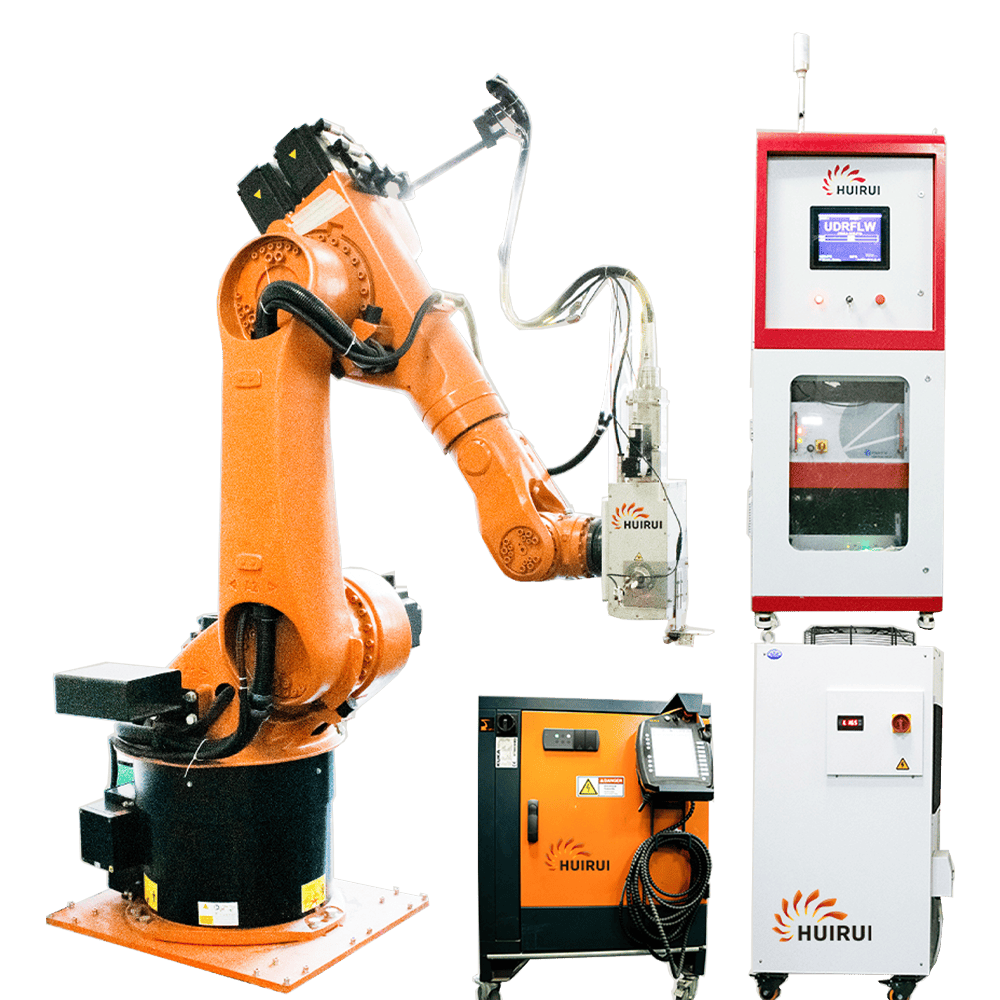
The iLAM-D-1004 laser quenching complete set of equipment was used for experiments. The equipment is shown in the figure. Its main configuration is as follows: 6-axis KUKA robot, 3000W Laserline semiconductor laser, laser quenching head spot size adjustment range is 3.5mm*3.5mm-21mm* 21mm. In addition, the system is equipped with a two-color pyrometer and 900-1500°C closed-loop temperature control software.
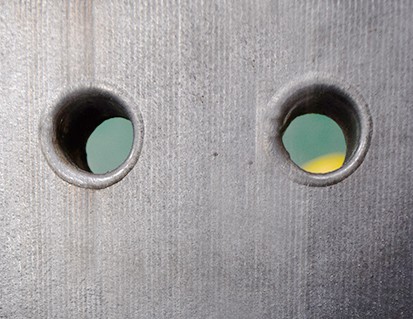
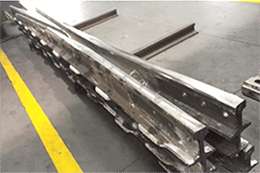
processed samples

Two-color pyrometers
Two-color pyrometers, Laser Line AutoZoom two-way adjustment and shaping module, which is suitable for quenching heads for medium and high-power industrial applications. The adjustable rectangular light spot with uniform energy distribution can be applied to the surface treatment of parts of various sizes. The variable spot lens group can adjust the length of the homogenized square spot by driving the motor. The built-in motor driver can choose standard 0-10V analog control, and the power supply requirement: is 24V/3A; the lens can be equipped with an infrared pyrometer to achieve closed-loop temperature control. Adjustable light spot range: 3.5-21
Temperature Closed Loop Control
Temperature closed-loop control LASCON® is a laser controller software for temperature-controlled laser processing. Two-color thermometers are used to detect processing temperatures. Main applications include laser quenching, micro-hardening, and laser welding (especially laser welding of plastics) as well as any process that causes the temperature of the workpiece to increase, such as induction heating. LASCON® controls optimizes, and supervises laser processes. Using a simple laser process scripting programming language, LASCON® is able to determine good and poor laser processing and can easily pick out bad parts in laser-supported production. The software supports specially developed hardware components such as the LPC04 controller, which integrates high-speed infrared pyrometers, laser processing heads, calibration units, and adapters. Easily integrated into machines and factory equipment. The entire software package is divided into different units that communicate via TCP/IP protocol.
The principle of material quenching is to heat the material to a temperature above the critical temperature Ac1 (738°C) or Ac3 (912°C) and keep it warm for a period of time to make the material structure fully or partially austenitized, and then cool it at a rate greater than the critical cooling rate. Rapid cooling to room temperature leads to martensitic transformation. It is known that the laser quenching temperature obviously has an important impact on the quenching quality, and the quenching temperature is determined by the quenching process parameters. Different quenching process parameters determine different quenching temperatures. The quenching temperature is also a more intuitive parameter for repeated quenching processes. Therefore, During the laser quenching process, infrared monitoring is usually used to measure the material quenching temperature in real-time to control the quenching temperature within a reasonable range. The temperature closed-loop feedback system is used to adjust the laser quenching process parameters (mainly adjusting laser power) in real-time to stabilize the quenching temperature at an appropriate value.
Process Test
The experimental material is pre-hardened plastic mold steel 2738, with a pre-hardened hardness of 29-33HRC. This material is mainly used in large plastic molds and mold bases, such as car bumpers, TV casing molds, etc.
Based on the research on the relevant literature in the early stage of laser quenching, a preliminary experimental design was carried out. The quenching form was single-pass quenching. The laser spot size was 10mm*10mm and the spot scanning speed was set to 10mm/s. The effect of the size of the experimental substrate on the quenching quality was ignored. The default absorption rate of experimental materials for the laser is 100%. By setting different quenching temperatures, the quenching hardness of the material and changes in the depth of the quenching layer can be detected. At the same time, the actual light output of the laser can be calculated and displayed in real-time through temperature control software conversion. power.
From the Gallary diagram, we can see the quenching surface conditions under 6 sets of parameters. The surface oxidation of 1# and 2# after quenching is shallow, the quenching temperature is low, and the traces left when the base material is polished can be clearly seen, and 1# is single-pass quenched. The width is too small; the surface oxidation of 3#, 4#, and 5# after quenching is moderate, basically covering the traces left when the base material is polished, and the quenching temperature is moderate; the surface oxidation of 6# after quenching is serious, there is surface peeling, and the quenching temperature is too high. high.
Surface Hardness Testing
The quenching hardness is measured using a Leeb hardness tester, and the specific measurement values are shown in the Gallary table. It can be known from the hardness value that the quenching temperature of 1# is obviously insufficient, the quenching hardness is low and fluctuates greatly; the average quenching hardness of 2# is 52.9HRC and the hardness value fluctuates little. However, according to the material characteristics of pre-hardened plastic mold steel 2738, the quenching hardness can reach Above 55HRC, it is obvious that the quenching temperature of 2# is slightly insufficient; the quenching hardness values of 3#, 4#, 5#, and 6# are all above 55HRC, and the quenching hardness of 5# is close to 60HRC, and the hardness fluctuation range is around 1HRC; comprehensive quenching surface Condition and quenching hardness, it is initially believed that under the 10mm*10mm spot and 10mm/s spot scanning speed, the reasonable range of quenching temperature is 1200℃-1400℃, the corresponding laser power density range is 1680-1980W/cm2, and the laser surface energy density The range is 840-990J/cm2, among which the 5# quenching process parameters are the optimal parameters for this experiment.
Hardened Layer Depth
Cut the quenched single-pass cross-section, prepare a metallographic sample, and use 4% nitric acid alcohol solution to corrode the section. Through the Vickers hardness test, it can be known that the effective depth of the quenched layer is the difference between the quenching surface and the single-pass quenching heat influence. The effective hardening depth of sample 4# is 0.9mm, as shown in the Gallary diagram, and the hardness value from the base material to the surface of the hardened layer is shown in the Gallary hardness table.
Device parameters | |
robot | 6-axis KUKA robot |
laser | 3000w Laserline semiconductor laser |
Laser quenching head spot size adjustment range | 3.5mm*3. 5mm-21mm*21mm |
System configuration | Two-color infrared thermometer |
900-1500℃ closed-loop temperature control software | |
Process parameters (note: laser full power 3000W)-process test | |
Quenching temperature range (℃) | CC |
Laser power range (%) | coaxial toroid |
Power density range (W/c㎡) | water cooling |
Area energy density range (J/cm2) | 0.5-1.5mm |


Related products
HUIRUI only makes the best products in this industry


